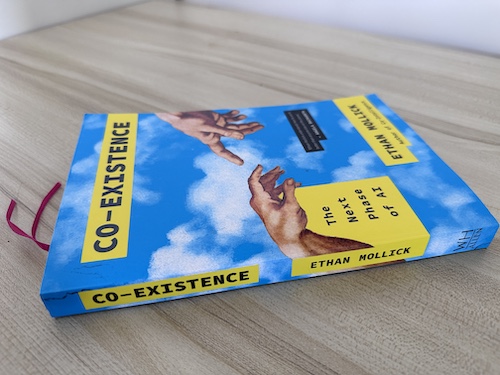
Ethan Mollick’s book Co-Existence: The Next Phase of AI (2026) expertly continues his personable and hopeful approach to explaining Generative AI and how it’s impacting our world, and speculating on future trajectories. Academia does not have many public intellectuals anymore, but Professor Mollick is one of them. I really enjoy following Mollick’s work on LinkedIn so I was excited to get my hands on this follow-up to his 2024 book, Co-Intelligence.
The book is organized into 11 chapters, with two brief codas that show Claude AI’s writing and with a short conclusion by Mollick acknowledging the shifting sands in the world of writing in the age of AI. I could have done with a book twice as long – hearing Mollick think through the changes in AI in the past couple years and what they might mean is refreshing. You can hear his voice, and he cleverly weaves in AI and questions his own process along the way. Maybe it will become a historical artifact showing how some of the smartest minds dealt with this new technology before it became so commonplace as to not be worthy of discussing in detail.
A key theme is how “today’s AI is much more capable than most people think” (pg. 3) – something that’s clear in many discussions of AI with people not following the news or using it themselves – and that much stronger AIs are coming. He’s hopeful that humans will have a large role to play in the societal changes happening now and those coming down the line, and shows how people can develop a better mental model of AI capabilities. For anyone still using AI as a search engine replacement, this will be particularly useful information.
Mollick acknowledges that AI systems are advancing quickly and even in the time since writing his last book, they have improved significantly. There’s a sense of momentum that underlies this book, even more than the previous book; a sense of AI can’t do this yet, or that things are this way for now but the situation could very well change and likely will change.
He updates us on the Jagged Frontier from the last book with a diagram and explanation showing just how much AI capabilities have expanded. The circle of what used to be an easy task for humans has almost been completely taken over by AI, and AI has made quite a lot of inroads into the circle of what is a hard task for humans. In fact, it’s even popping out beyond the limits of human ability in some areas. This is one of the challenges with AI: you don’t necessarily know where it’s going to be good or where it’s going to have limitations until you encounter them yourself. But the only way to encounter them is to use it and to keep pushing it.
Although I’m not the target audience for the explanations of how AI works, I still find Mollick’s examples interesting to read. And they are also a useful condensed history of the last couple years of changes in prompting and reasoning with AI models. For example, he discusses the shift from prompt engineering to context engineering, and how we should move to prompting AI as a manager would prompt a consultant or new hire on their first day. This means thinking beyond the usual documentation we default to (like a static report) and seeing if a dashboard or prototype might be a better result. This is something I point out a lot to beginner users, who are frequently amazed that AI can do more than write things.
Mollick builds on his previous analysis of the approaches to working with AI, adding a third approach, conjurer work, to centaur work and cyborg work. This is the world of agentic AI that 2026 has introduced, and he says it requires different skills, more managerial skills than anything else. I haven’t been too impressed with managers; maybe this will precipitate investment into better management training, or will mean years of underutilizing agentic AI until humans can catch up.
Mollick covers when not to use AI as well, and the four advantages humans have, including deep knowledge and expertise in an area that let you intuitively make decisions. Herein lies the challenge for students and entry-level workers who have not yet developed this expertise and may be short-cutting themselves by relying too heavily on tech. But for all of us who have already developed such expertise, it is an advantage, one that Mollick stressed in his last book and that I highlight to people hesitant about touching AI. In writing about what’s essential in working with AI, he notes, “Done right, it expands your capabilities and makes you more creative than you were alone. Done wrong, it atrophies the very skills that matter most.” (pg. 92). He wants people to avoid being so cautious about potential hallucinations or de-skilling that they avoid AI entirely and keep doing tedious work that isn’t a good use of their time.
The book relates the O-Ring theory and Garbage Can Model to AI, and how bottlenecks and undocumented processes can hamper AI’s impact within organizations. For anyone who has worked within a traditional organization and been disappointed by the bureaucracy and resistance to change, this part of the discussion will be painfully familiar. Mollick considers leadership to be a critical factor in what is going to happen in the future with AI and work, and that the current trajectory of either firing or heavily monitoring staff is not looking very imaginative. I liked that he acknowledges we don’t know what will happen with AI and jobs, and that basing our predictions off of a sample size of three previous industrial revolutions is not enough to go on. I prefer this honesty to the approach that AI is just another piece of technology that can be absorbed like all the previous ones and not really transform work. It may take longer than those at the cutting edge like, but transformative change is coming.
As a writer cautious about how much I let AI into my process, I found it useful to see him giving specific examples of how he uses AI as a partner in writing and how it has transformed his work. Although he has some reservations about where this kind of collaborative process may end up, for now he appreciates how it can assist him with areas of writing that he’s not as good at, like closing a paragraph, or occasionally reducing writer’s block. He goes into interesting dialogues with AI and shows how much it can actually write like him once it’s been trained on his work. He explores the struggle in deciding how to avoid things sounding like they were written by AI, admitting that he removed many of his beloved em-dashes to avoid that telltale AI sound. I have also found myself altering things to avoid the AI look, and many writers will likely agree there is a tension here in this period where AI-generated content is swamping online platforms.
I appreciated his perspective on the use of authors’ works for training, a controversial topic that has fueled some backlash and a vibe in authors’ circles that AI is bad. Perhaps it’s in part due to him not needing to make a living solely from being an author, but he discusses in positive terms the possibility of having ongoing influence in the future if your work is part of AI’s training data. I hadn’t heard this view before and it resonates with my move to make my science fiction scholarship accessible through one of my websites, rather than letting it remain trapped behind academic paywalls. We know most authors can’t make a full-time living from publishing books; for everyone else who still writes because they can’t not write and is interested in having an impact on the world, Mollick’s perspective is worth considering.
My least favorite part was the section on AI and education. Mollick’s discussion of how AI could change education such as through universal tutors isn’t all that convincing. For all his leading efforts working within the educational system at the University of Pennsylvania in the US, Mollick is still part of the system and isn’t proposing anything too disruptive to it. He acknowledges that the Homework Apocalypse from his first book is still a threat that institutions need to address, lest their credentialling function cease to exist, but there isn’t anything daring in this section. You have to follow other educators pushing the boundaries for a more transformational view of what education could be in the future. The ‘add custom chatbot and stir’ approach isn’t doing it for me.
There were a couple typos in the book, maybe part of the proof it was human-written? You never know with Mollick. The cover itself has the telltale AI hand with too many fingers, surely intentional. I like that I can be encouraged into new thought patterns about AI when reading Mollick’s works. He’s not talking down to us but having a convivial conversation about something he lives and breathes every day.
He closes the book with two scenarios for where we go next: the Escalator (gradual or sporadic progress) or the Eschaton (superintelligence that changes everything). But what he does best is give us hope regardless of what happens. He advises us to redesign organizations and invest in training and think of AI not “as a tool to be adopted but as a force that reshapes our world” (pg. 199). He emphasizes that right now we have the agency to shape how AI impacts our world, so we can make a difference. It’s my mission so I wholeheartedly agreed! Don’t do nothing and don’t only think about today’s AI, he says. It’s a hopeful ending to a book acknowledging all of the uncertainty and potential out there with AI. Mollick’s Co-Existence is a must-read and worth your time.
Co-Existence: The Next Phase of AI is published by WH Allen, part of Penguin Random House. This post contains affiliate links; if you purchase through these links, we may earn an affiliate commission.