Karen Hao’s Empire of AI (2025) is a must read for those working in the AI space regardless of whether you agree with her principal position, which is one of resistance to Generative AI as currently developed by the major tech companies. Her book explains so many things about how this generative AI technology has been foisted onto the world, including why it seems there was no marketing strategy for ChatGPT, an AI product that has significantly affected the world.
Empire of AI is structured as a narrative, making it easy to follow along with the rise of AI company OpenAI. Hao explains in her opening author’s note that although the story focuses on one company, she intends for it to be part of a broader critique:
“While it tells the inside story of OpenAI, that story is meant to be a prism through which to see far beyond this one company. It is a profile of a scientific ambition turned into an aggressive ideological, money-fueled quest; an examination of its multifaceted and expansive footprint; a meditation on power.” (pg xii)
Her inside view was made possible by her extensive interviews with people at the top AI companies—including OpenAI, Google, Anthropic, Microsoft, and Meta—and her research into correspondence and documents. This gives the book a rich perspective that goes beyond what you find in traditional media and the short-form pieces about the world of AI that often don’t say enough to really understand what’s going on.
There are 18 chapters and a prologue and epilogue with short titles that point toward her argument, ranging from “Divine Right” to “Disaster Capitalism” to “A Formula for Empire”. She opens with the drama-filled firing of OpenAI CEO Sam Altman in November 2023—about a year after the release of ChatGPT—and the concern that the governance of AI developments is not open to public scrutiny or democratic principles. Her chosen metaphor that underpins the book is that the AI companies are empires, like those of European colonialism in ages past: they extract resources, consume land and energy and water, and exploit human labor, and aggressively push their ideas under the guise of modernity and economic opportunities.
Hao’s attention to detail and journalistic pursuit of bringing together her pieces of evidence into a coherent trajectory shine through in the story as it takes shape. The book is not a dry retelling of a company’s formation but an interesting peek behind the curtain of a technology-focused organization that has burst on the scene and seemingly veers from one announcement to another, forcing other more established players to respond in its wake.
What I found particularly interesting was learning more about just how rushed the release of ChatGPT was, after the rival company Anthropic was rumored to be preparing to release a new chatbot. Hao details the events of late 2022 when OpenAI hastily put together a new chat interface in a couple weeks to be able to launch ChatGPT as a research preview, expecting that it would be like their release of the DALL-E 2 image generator and have a brief viral moment before quieting down. Of course, that’s not what happened. If you’ve ever wondered why the name is so clunky and there doesn’t seem to be a strong marketing strategy for product releases at OpenAI, this story helps explain things.
Hao also spends time with communities outside the U.S. where the impact of exploitative labor practices are being felt. She explores resistance to data centers and the labor conditions of people in countries like Kenya and Venezuela that are doing low-paid remote data annotation work, some of which involves exposure to violent and abusive content.
The epilogue closes with what Hao views as some hopeful alternatives to the AI-as-empire concept, including Te Hiku Media in New Zealand led by Peter-Lucas Jones or the Distributed AI Research Institute (DAIR) founded by Timnit Gebru, PhD, a former Google employee whose criticism of large language models led to her departure from the tech company amid controversy that Hao unpacks. I’ve met Jones and heard him speak at conferences in New Zealand about his work creating an ethically-trained te reo Māori speech recognition model (Papa Reo). It is a great project that showcases how a community can be involved in providing its data to a trusted organization and can manage its own servers without having to rely on a large foreign company.
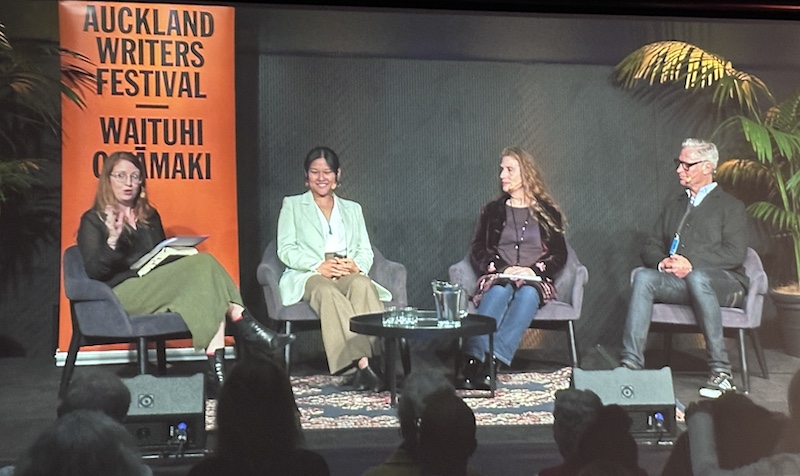
We absolutely need people like Karen Hao to ask the hard questions and to develop evidence-based criticisms of big tech and AI companies. In Empire of AI she has put together an interesting story of how OpenAI has developed and threaded it with insights into a range of aspects of AI that many people will be unaware of if they’re not following AI news closely. I was excited to attend two of her appearances at the Auckland Writers Festival in May 2026 and get my book signed. She was an articulate and interesting speaker and I wish there had been more time for her to engage with audience members afterward, since there was clearly a high level of interest and a range of opinions on the topic.
My main criticism of Hao’s book was her response to the argument she makes. She devotes a scant two sentences in the last paragraph of the book to calling for broad-based education on AI, including how it works and its pros and cons. Since educating people about AI is core to my mission of AI literacy for all, I was disappointed that this seemed to be such an afterthought.
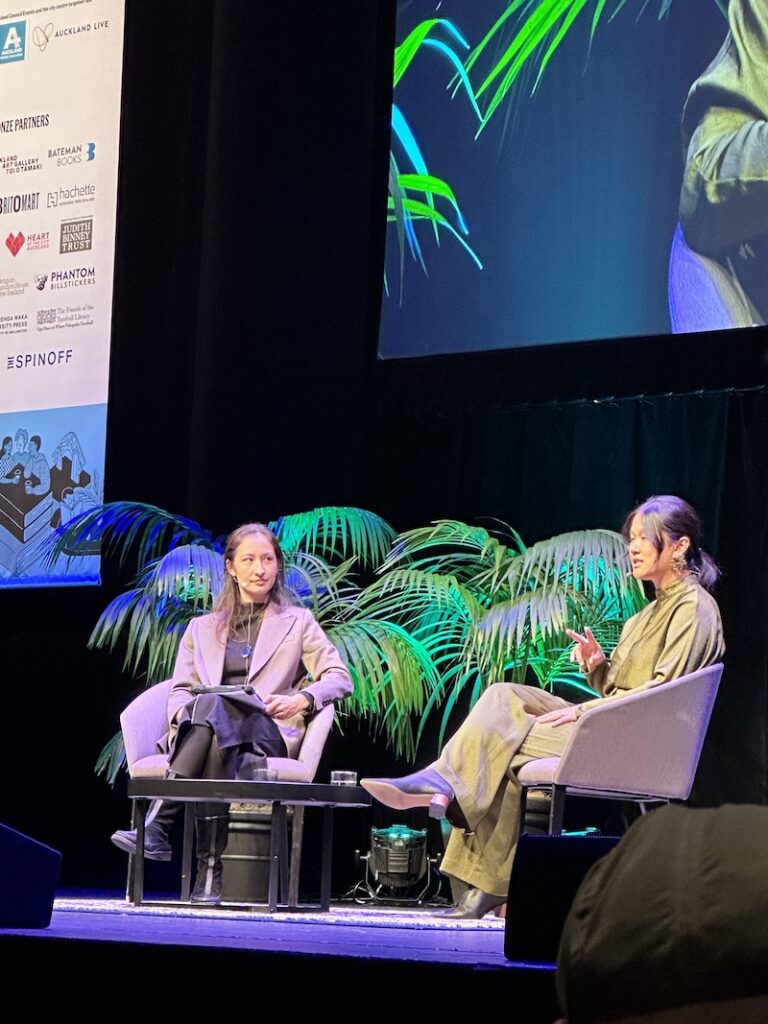
Furthermore, from what I have seen from Hao’s public appearances and online presence, she is much more interested in resisting generative AI than promoting education about it or any information about its usefulness. At the festival appearances I attended, she was pushing a few key soundbites from the book about how egregious the harms of AI companies are. She continually reiterated that she doesn’t use generative AI and feels it is being forced on people at work. Although she acknowledged that not everyone has a choice not to use it, and that she has seen writer colleagues use it to help them pitch for work and doesn’t begrudge that use, her position felt very elitist and one-sided. She holds a unique privilege of writing and interviewing people for a living (amid a struggling journalism industry) and not feeling the need to engage with generative AI. She promoted New Zealand’s Te Hiku Media as an idyllic example of AI used in service of the community, but this overlooks the realities of the globalized and competitive world we live in, where this is unlikely to be realistically scalable. Specialized, localized AI certainly has a place, but more likely trajectories for equitable data gathering exist, such as the Humans Commons and other initiatives to empower human content creators.
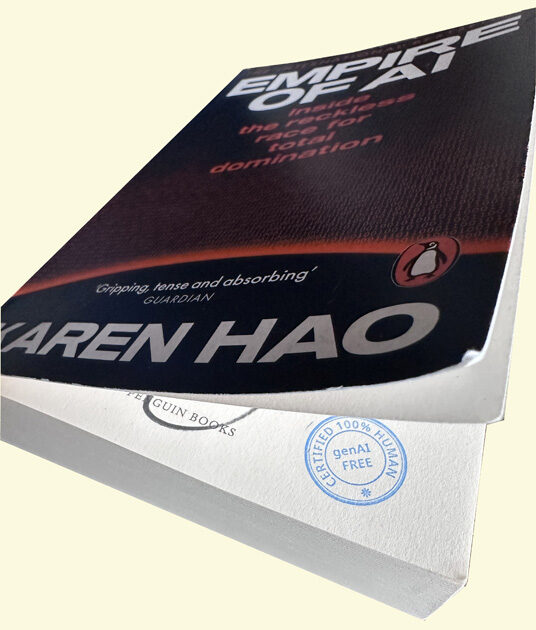
In addition, since she doesn’t use generative AI, Hao necessarily stands at a distance from the technology and its advancements and isn’t able to critique it in the way that those who use it can. It works so differently from previous technologies, there’s a limitation to this hands-off approach. Despite her proudly stamping her books with a “Certified 100% Human genAI free” mark, what this will actually mean in the future is in question. Writing is a complex process, and it is becoming near-impossible to conduct even basic research online without encountering generative AI – what will count as human or machine writing in the future, and will we penalize any writer who dares to navigate this space and can’t claim an AI-free label?
My main fear as I looked out at the festival audience of predominantly older women who love books was that Hao was encouraging them to not engage with generative AI at all, to see it as a threat to creative writing, as an all-or-nothing thing. Many of them will have had little to no exposure to AI news or information outside of Hao’s perspective, and I could see them taking her arguments as a call to not engage in learning about it or being able to engage in discussions about how to shape it more responsibly as it emerges across New Zealand.
Karen Hao’s book Empire of AI is an important contribution to the AI conversation, but it needs to be paired with other perspectives such as Ethan Mollick’s Co-Intelligence.
This post contains affiliate links; if you purchase through these links, we may earn an affiliate commission.