This AI Literacy Review for October 2026 covers foundational leadership and workforce insights, including IBM’s perspective on bridging the organizational AI literacy gap, HP’s research on balancing AI fluency with core human adaptabilities, a Harvard Kennedy School report exposing the workplace AI gender gap, the UK AI Council’s draft AI competency certification pathways, and critical commentary cautioning against “snake oil” in executive AI programs. In the civic and community spheres, initiatives range from local high school projects bringing digital safety to seniors to the Sundance Institute’s AI Literacy Hub for independent artists, an Australian national roundtable on community-based AI skills, and public library partnerships with Microsoft, Choice/Clarivate, and Clemson University to build critical AI skills. Healthcare advances highlight systemic AI literacy efforts at Singapore’s National University Hospital and international studies evaluating AI readiness among gastroenterologists in China and hospital nurses in Romania. In government, the European Union updated its EU AI Act literacy requirements to offer organizational flexibility, while state initiatives such as Utah’s executive order mandated AI training for state workers and the US Department of Energy hosted AI STEM jam sessions with educators. Educational initiatives spanned K-12 and higher education programs, including international framework studies, global youth and elementary engagement tools (such as Google’s AI Quest, Minecraft-based tool, and a prototype AI literacy game), institutional curriculum integration across major universities (including Indiana University, Brown, USD, St. John Fisher, Penn State, Ohio State, and UCSB), global case studies from Sub-Saharan Africa to East Asia, and scholarly discussions on faculty readiness, student equity, critical AI agency, and the nuances of AI literacy within second-language acquisition and admissions.
General
IBM’s Before you scale AI, fix the literacy gap by Phaedra Boinodiris says “Closing the AI literacy gap is one of the most important leadership challenges of the AI era” and that people make assumptions about what they mean by AI, don’t realize AI cuts across functions and workflows, and don’t have a clear person responsible for AI responsible outcomes from AI. She uses the analogy of race cars: “Why do race cars go fast? Because the car, the track, the instrumentation and the people operating them have all been built to specification. There are dashboards, trained engineers, skilled pit crews and drivers who know how to interpret what they’re seeing. Those capabilities don’t limit speed. They make speed possible.”
HP’s Work Relationship Index report suggests that more AI fluency doesn’t reduce the need for adaptability, critical thinking, and continuous learning, and that 66% of Gen Z workers say that having access to upskilling makes them less anxious about the impact of AI on their role.
The Harvard Kennedy School Shorenstein Center on Media, Politics and Public Policy publishes a report Are Women Being Left Out of AI? that shows a consistent pattern of women in the U.S. using AI less often, reporting less support for it at work, not appearing as much in public discussions about AI, and being less represented in AI development and outputs.
The UK AI Council Publishes their draft AI competency certification pathways, and they are looking for feedback until November 20.
KRON4 interviews Adya Tewari, a senior in high school and co-founder of the AI Literacy Project, about her work to educate seniors and students (2nd to 8th grade) about AI and digital safety.
The Sundance Institute launches the AI Literacy Hub, a home for AI literacy resources for independent storytellers and artists aimed at helping them understand AI and its implication and choose whether and how to use this technology in their work.
Good Things Australia and the National AI Centre are hosting a roundtable with leaders from government, industry, academia, and the community sector to discuss what the role of community-based AI literacy is in fostering AI skills in Australia.
In the World Economic Forum piece What does leadership in the age of AI look like in practice? Najwa Aaraj and Ahmed Al Shamsi discuss the role of leaders in the age of AI and a an AI literacy initiative in the UAE as a case study for combining learning and mentoring about AI to foster AI-era leaders.
In Watch Out For AI Ed Jeffrey Sonnenfeld critiques AI literacy programs and says CEOs need to be skeptical of potential snake oil being offered in such programs, and determine what executives actually need to know from a practical perspective.
In Empowering Children Through AI – NobleCamps Coffee Chats #4 Michael Perry-Clemons, Founder of YouMeWe NPO, shares his thoughts on how AI is impacting the non-profit space, particularly the lives of children in children’s homes and education.
Re Meta’s Muse AI agent: How do we include more fun and joyful elements in introductory AI trainings? Joel Gladd’s LinkedIn post wonders about how the uptake and popularity of Meta’s Muse AI agent reveals the limitations of AI trainings that are overly critical of the tech and don’t capture what it means now. Also, Gianluca Miscione’s LinkedIn post on Meta’s Muse notes that AI privacy is becoming a trickier thing when other people give AI access to their email inboxes and files which means you can’t really opt out if everyone around you is opting in.
Punya Mishra in Acronym Chosen First satirizes the proliferation of AI literacy frameworks and shares some of his students’ 45-second audio commercials also satirizing AI literacy guidance.
OpenAI releases data on the real-world use of individual ChatGPT use across Free, Go, Plus, and Pro accounts, with heavier usage by 18-34-year-olds and evidence that the gender gap may be evening out.
Healthcare
Aymeric Lim Is Building AI-Literacy for a New Generation of Health Care covers the efforts of Professor Aymeric Lim, CEO of National University Hospital in Singapore, to make NUH AI-literate through capability building across all job areas, with 47% of the 9,000 staff already having completed structured AI training.
What an AI-literate health system requires: Johns Hopkins, Baptist Memorial + others weigh in is an edited interview from a session at Becker’s 11th Annual IT + Revenue Cycle Conference: The Future of AI & Digital Health featuring medical professionals discussing AI literacy, governance, guardrails, and actions for the next year to strength AI literacy and innovation.
In Artificial intelligence literacy and associated factors among gastroenterologists in China:
findings from a multicenter survey with nationwide geographic coverage Yangyang Zhang et al. discuss findings from studying the AI literacy of gastroenterologists across 96 hospitals through the Medical Artificial Intelligence Readiness Scale for Medical Students (MAIRS-MS), including that AI literacy was associated with education level, region, AI tool use frequency, training, and use in medical practice.
In Artificial Intelligence Legal Literacy and Procedure-Concordant Use of an AI-Enabled Early-Warning System Among Hospital Nurses in Romania Alina Doina Tănase et al. look at whether AI legal literacy is associated with the use of an AI-enabled early-warning system in 87 nurses in a tertiary university hospital.
Government
The European Union (EU) replaces Article 4 of the EU AI Act regarding AI literacy with updated wording that provides more flexibility with the level of AI literacy of staff using AI systems at an organization.
Utah Governor Spencer Cox signs an executive order that requires AI literacy training for state government employees, directs government agencies to use AI for internal process streamlining, and sets out guardrails to avoid security failures.
The US Department of Energy’s Argonne National Laboratory fosters AI literacy through AI STEM learning experiences that help educators bring AI knowledge into the classroom, such as through a summer mini jam about creative ways of teaching AI concepts through planetary-themed activities.
Libraries
Microsoft announces an AI literacy initiative with the Public Library Association, Building AI Skills and Agency Through Libraries, to help library workers and patrons build skills, critical awareness, and judgment around using AI.
Choice and Clarivate’s AI literacy micro-course for librarians included survey questions about whether libraries were investing in staff training to adopt AI tools, detailed in the post Two Quick Charts on AI Workflows in Academic Libraries (and Other Takeaways): What our micro-course participants had to say about library AI workflows.
In Who Keeps the Catalog of Connectors? The Coming MCP Discovery Problem Lisa Janicke Hinchliffe explores the idea that libraries treat Model Context Protocol (MCP) connectors (that link AI tools with websites and other tools and apps) like a collection. This would involve keeping a register of them and asking providers to describe connectors and metadata in machine-readable form for libraries.
Clemson University Libraries hires two graduate students as AI Ambassadors to help develop students’ AI literacy skills through AI training and workshops created by students, for students.
Education
Google’s third AI Quest lesson is called Polar Peaks and focuses on the neuroscience topics of mapping the human brain to teach students AI literacy skills.
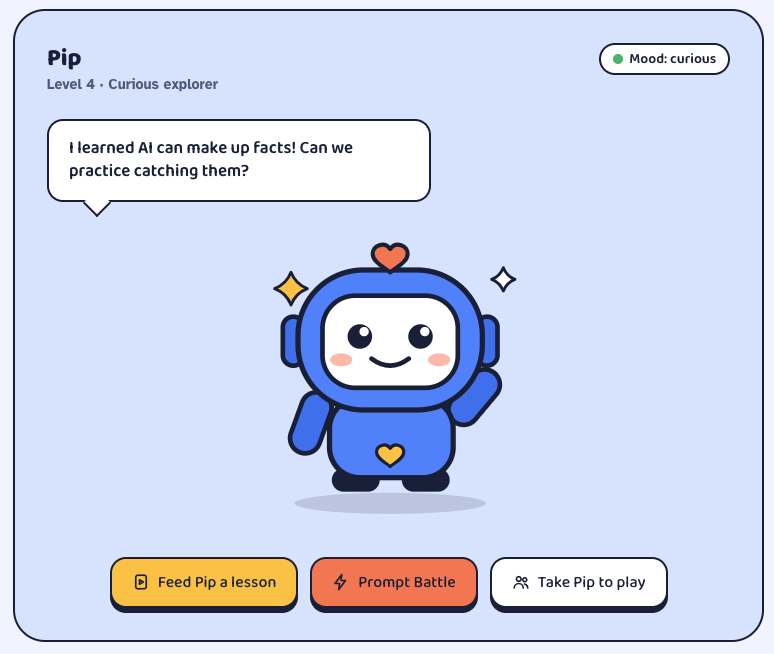
A prototype of an AI literacy platform for kids called Pip is created by Nancy Wang and four other women at Ruth AI Inc. and Google’s AI for social good hackathon, drawing on games such as Club Penguin and Tamagotchi to make AI literacy fun and collaborative.
The international webinar AI Literacy Across Borders: Responsible Use of Artificial Intelligence Among University Students in Malaysia and Indonesia available on YouTube shares perspectives on AI from panelists in Malaysia and Indonesia.
The Florida Department of Education partners with Florida Atlantic University on the Literacy Education for Augmented Praxis by Artificial Intelligence (LEAP-AI) initiative, concentrating on 18 high-need schools and providing support for teachers through AI and literacy micro-credentials, coaching, and communities of practice.
Indiana University’s GenAI 101 becomes a national model for AI literacy shows how the course has proved popular, reaching 114,000 learners across 9 campuses and is open not only to alumni now but anyone in the world for free. A GenAI 201 course is planned to go deeper into business application, ROI, governance, and other topics.
Brown University’s Seminar on AI literacy will see ten three-person teams create or modify a class to help develop students’ AI literacy across disciplines, with each team including a faculty member and a student and courses including chemistry and East Asian studies.
University of San Diego launches a 15-part video series called TritonAI Discovery to help people understand AI concepts and engage with AI tools, with videos written and presented by subject matter experts and averaging around seven minutes.
St. John Fisher University launches a minor in AI literacy housed in the School of Arts and Sciences that includes three foundational courses and three elective courses.
Acadia researchers revamp free AI literacy course to version 2 called AI for Everyone: Critical AI Literacy, responding to changes in the tech and incorporating feedback from the first version, such as that the concept of cognitive debt was one that learners resonated strongly with.
Penn State’s Incoming first-year students build AI literacy in summer engineering programs by Emily Liu covers the engineering programs’ summer activities helping students build AI literacy skills.
Ohio State University plans to hire 100 AI-focused faculty in the next five years to ensure every student graduating by 2029 is AI fluent no matter their major.
UC Santa Barbara’s program to develop AI literacy for employees, the AI@Work Certificate program, brings 30 people together for 9 weeks to learn about AI platforms and tools.
The Computing Research Association, CSforALL Alliance, ACM, and CSTA develop the Defining AI for Computing Education Framework to help support a shared understanding of computer science, AI, and AI literacy.
In Computational and AI Literacy: Lessons Learned from Computer Science Education Sharin Jacob et al. explore the intersection of computational thinking and AI literacy and offer a framework that integrates AI literacy into current computational literacy models.
In How do institutions embed AI literacy in higher education? Petra Recter discusses Oxford University Press’s development of an AI literacy module to support educators in teaching students the fundamentals of AI.
The Higher Education Policy Institute blog Every student needs a minimum AI requirement by mathematics teacher Roney Lima do Nascimento calls for a minimum AI learning entitlement by the end of a student’s first term, not an optional workshop that at-risk students are likely to miss.
The Conversation piece Universities are making different choices about AI. How will they fit with their public missions? by Nadia Delanoy at the University of Calgary discusses her and Guy Levesque’s systematic scan of publicly available AI activity at 15 Canadian universities in the first half of 2026 to see how and where AI initiatives are evolving, with 953 initiatives identified and only 9% explicitly instructor-facing teaching ones. It is suggested that responses to AI need to invest in human capacity not be solely tool-centered with some guidelines and adaptation assumed to follow.
The Students for AI Literacy (SAIL) nonprofit based in Cincinnati, Ohio is interviewed by WCPO9 about their expanding efforts for peer-to-peer AI literacy education in schools.
In What AI literacy looks like offline: An ASU Mastercard Foundation Scholar’s Kenya pilot teaches AI literacy through storybooks and reading clubs. Kelly deVos details the efforts of Martin Mwangi Ndegwa, a master’s student in data science, analytics, and engineering at Arizona State University, to bring AI and data literacy to Kenyan students, and the challenges of a lack of reliable electricity, devices, and internet access.
MICFIS International School Students Take Their First Steps into AI Literacy covers the African Institute for Artificial Intelligence’s outreach efforts to help students gain practical and critical AI skills at MICFIS International School in Ibadan, Nigeria, including fundamentals, prompt framework, responsible innovation, brainstorming, and the creation of an AI club. Organizers also identified a low baseline in computer literacy since students were mobile-first, and a baseline digital literacy gap more common in female students.
Oberlin College and the Association of Independent Colleges and Universities of Ohio (AICUO) host a daylong symposium titled AI and the Human Future of Work and Learning in Ohio where participants shared insights such as the campus survey showing 40% of faculty using Gen AI weekly and 60% of first-year students having already used AI, which informed the development of the critical AI studies minor that launched in the fall.
In Beetrap-MC: A Minecraft-Based AI Literacy Tool for Teaching Filter Bubbles to Middle School Students Erfan Farhadi et al. use a Minecraft-based augmented reality application called BeeTrap-MC to teach AI concepts such as filter bubbles to middle school students.
In Times Higher Education’s AI literacy as habit, not bolt-on Lucy S. Méndez Santiago from the Universidad del Caribe (UNICARIBE) calls for AI literacy to be a quality of design and woven into course tasks and assessments so students must exercise judgement about AI and build habits around the technology.
The University of Kansas covers the publication of On “AI Literacy”: The Rhetorical and Historical Fallacies of a Movement and Its Marketing by Sean Kamperman and Harvey J. Graff and the authors’ critique of what they view as the uncritical adoption of AI education frameworks and the way the term AI literacy is used without a grounding in literacy itself.
In Readiness shouldn’t mean surrender: The two faces of AI literacy Mike Taubman shares an upcoming AI literacy lesson on reviewing AI company CEOs’ visions for AI with students and encouraging them to be prepared to shape our AI future (agency) not just live within the visions that others have (surrender).
In AI Literacy Was the Starting Point. AI Agency Should Be the Goal. Jody Britten offers a definition of AI agency as having the knowledge, judgement, and ability to make choices about how AI affects them, and the questions to ask when trying to frame AI agency in education.
In IB Theory of Knowledge may be the AI literacy course our students actually need IB educator Jeff Lippman shares a lesson incorporating Theory of Knowledge (TOK) for students using a Claude-co-created video and conversations about consciousness and authorship.
Seton Hall University’s Faculty Matters podcast episode What Do We Mean by AI Literacy? features librarian Maria Barca and data specialist Samah Alshrief discussing what exactly we mean when we talk about AI literacy and how students and faculty can achieve AI literacy.
In Towards a Multidimensional Framework of AI Literacy in Education: An Umbrella Review of Conceptualizations, Components, and Multilevel Influences Maarten Renkema et al. develop a comprehensive framework for AI literacy in education that includes three components: knowledge of AI, skills with AI, and AI attitudes and emotions, with a fourth dimension, Ethical Awareness, cutting across the others.
In Structured AI-Integrated Learning (SAIL) in business and management education for developing AI and prompt literacy [paywalled] Antigoni Papadimitriou and Zilong Pan discuss the use of the RACE framework (Role–Action–Context–Explanation) in an undergraduate Organizational Behavior course to help guide students in designing prompts, evaluating AI outputs, and connecting to theory, with results showing significant improvements in AI literacy and prompt literacy.
Video panel Local Control Shared Support: Bringing AI to Nebraska Schools features Guy Trainin and Azadeh Hassani interviewing Nick Ziegler, EdTech Specialist at ESU5, and Andrew Easton, Chief Learning Officer at the ESU Coordinating Council, about how Nebraska’s Educational Service Units help rural schools with AI integration in education.
The University of Maryland Global Campus’s episode of Unstoppable Stories titled Building True AI Literacy, host Nathan James interviews faculty members Dr. Kate Goldberg and Mary Crowley-Farrell about AI literacy going deeping than prompting, digital awareness, and issues of equity.
The white paper Life Course University: Why Longer Lives Are Higher Education’s Untapped Strategic Advantage by Simon Chan and Lindsey Beagley discusses the Life Course University as a framework for reconsidering higher education in the wake of longer lifespans, changes in demographics, technology like AI, and opportunities for lifelong learning.
In Exploring AI literacy in elementary classrooms: students’ perspectives on generative AI, fairness, and ethical use [paywalled] Panagiotis Kosmas and Andria Agesilaou look at elementary school students’ AI literacy development via structured, age-appropriate educational interventions.
In Teacher AI Literacy as a Core Professional Competency for Twenty-First-Century Education Joseph Baidoo and Thamsanqa Sihele from Walter Sisulu University in South Africa propose the Teacher AI Literacy (TAI-L) framework, drawing on four other international frameworks, and confirm the gap between policy and reality in under-resourced and rural contexts such as the Eastern Cape and Sub-Saharan Africa.
In An integrated model of executive function, AI literacy, and Chinese L2 reading comprehension among ethnic minority adolescents in Hong Kong Zheng Liang Sun and Yau Yu Chan discuss the relationships between linguistic and reading skills and AI literacy in students in Hong Kong, finding that AI literacy significantly supported foundational reading skills and reading comprehension.
In How AI literacy predicts L2 Chinese writing engagement: the mediating roles of anxiety and enjoyment Chenrui Miao et al. find that AI literacy reduced anxiety in learners and empowered them to transition to confident editors.
In Engagement in AI-Mediated Informal Digital Learning of English: An Adaptive Intelligence Perspective on Motivational, Psychological, and Technological Resources Quan Quan et al. study how the relationships between AI literacy and L2 motivational selves and engagements in over a thousand Chinese university English language learners.
In AI literacy in student translation practices: evidence from ChatGPT use in Hong Kong
Hao Yin et al. study students’ AI literacy through a multidimensional framework covering knowledge, usage, evaluation, affect, and ethics in the context of translation tasks.
In Artificial Intelligence Literacy in Engineering and Technical Education: A Systematic Review of Research Trends, Competencies, and Emerging Directions Khusnul Khotimah et al. review AI literacy research and the trends and major themes over the past decade.
In Generative artificial intelligence literacy profiles differ in academic self-efficacy and subjective well-being among adolescents Ja-Yeoung Lee studies the AI literacy of Korean adolescents using the ChatGPT Literacy Scale.
Inside Higher Ed’s AI Literacy and the New Admissions Disadvantage by Finn Anderson covers the challenge in economically disadvantaged school districts lacking the funding and resources to incorporate AI tools and training into curricula, potentially disadvantaging students applying for colleges that expect them to have AI literacy and that may penalize them for poor use of AI in their admissions essays.
Michelle Kassorla critiques the dated guidance in the University System of Georgia’s updated USG Student Guide to Generative AI Literacy, nothing that it still centers on the single-prompt chatbox, doesn’t cover AI agents or multimodal examples, overemphasizes old prompting tricks, and relies on passive fact-checking advice. [The guide also directs students to learn more by going to the tech companies’ websites, rather than independent, learning-focused AI literacy resources.]
Jason Gulya places twelve AI guides for students, faculty, and professionals on a website to help them make informed decisions about AI usage in education.