The key messages at the Aotearoa AI Summit 2026 (conference held in Wellington, New Zealand on September 8-9) were that the New Zealand Government’s light-touch approach to AI isn’t working, and that New Zealand has real opportunities to be a strong, trusted middle player in the AI space. It was refreshing to see how far along the discussion had moved from last year’s summit, with encouragement to build capabilities and harness New Zealand’s strengths while fostering trust and aligning with ethical principles. The level of discussion felt more focused on strategic direction, perhaps due to the aforementioned light-touch approach that is leaving it to individuals and organizations to figure out what to do about AI in New Zealand.
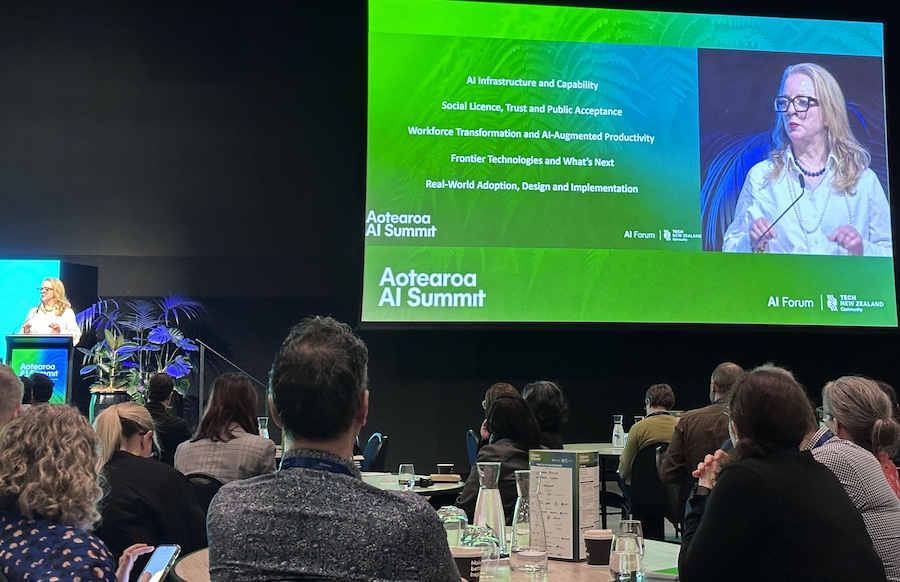
It was interesting that speakers from the Labour Party and Microsoft happened to be first up, considering how both seem to be struggling to be seen as leaders in their respective spaces. I have been disappointed at how little AI has been an issue in the upcoming election – this is transformative technology with impacts across workplaces and society at large. The continual calls for leadership at a national level to mirror what Australia is doing indicate that there is a strong appetite for a change in how New Zealand approaches AI technology.
Below are some of my notes on things I found interesting or worth documenting (not a full summary of everything), along with links and photos. As a side point, I will say it was tiresome to see so many generic AI-generated slide decks, one after the other – these tend to have small text not readable at the back of a room, lots of items competing for attention, and the same formatting and design. Regardless of how visuals are made, it’s important to follow good design and accessibility principles. Here’s hoping that by this time next year, there are lots of flourishing AI start-ups and clear policies and implementation frameworks moving New Zealand along on the AI journey.
Conversation: What is the role of AI in Aotearoa going forward? Will Mace (Chief Reporter, NBR) and Reuben Davidson (Labour Party’s spokesperson for Economic Development, Science, Technology & Innovation)
Mace asked Davidson whether or not he uses AI and Davidson said he does and gave an example of how he uses it while driving to download his brain to delegate things to his team, enabling him to get to stuff that used to fall to later pages in his notebook, and his team has noticed his increase in productivity! He’s getting people coming up to him 2-3 times a week to ask about data centers; there’s a misconception that these are new and going to cover the South Island. New Zealand can be the right place if it manages environmental impact and power. There’s a lack of clear info to ensure people come with us on this journey, a risk of increasing the digital divide, and a risk that AI opportunities are not understood and able to benefit people. The process is as important as the outcome (and the current Government is keeping quiet if they are doing anything). Small businesses may see using AI as “bought a laptop w/ Copilot on it”.
He said we need to give certainty to the science and innovation sector and pipeline to keep R&D here, but we also need New Zealand to be seen as a good place for AI externally. He critiqued the Government’s ‘light-touch’ as not the right approach; we don’t want to constantly chase regulations for AI but do need to harmonize with Australia’s approach. His criticism of the Government included a lack of strategic vision for AI in the public sector context; there’s no budget/cost factored into that, and it’s just seen as getting rid of public sector jobs. Big Tech have been vocal about upskilling initiatives, and the Government should have a long-term strategic picture of how upskilling and disruption will go, such as microcredentials or shifting roles.
He wasn’t able to talk to Labour’s AI Action Plan because it was set to be released the day after his session, but he said broadly it would help businesses to provide training and guidelines (risk is shadow AI usage otherwise). He believes transformative change is possible, if governed well, and that regardless of the upcoming election outcome, parties need to work together.
Keynote: The Age of Intelligence: Why the next decade may matter more than the last fifty – and what it means for New Zealand, Martijn Verburg (Head of Engineering, Microsoft)
Verburg made the first science fiction reference of the day, noting that he enjoyed SF as a teen and didn’t think he’d see it in his lifetime. I always like to note how long it takes for sci-fi to be mentioned at any conference or seminar, especially when tech is involved, and increasingly it is mentioned early on and frequently!
AI is permeating everywhere, he said, although I know that’s not actually true – plenty of people have not used it or aren’t using it much. When you step out of the AI bubble, adoption is uneven and not as widespread as you’d think.
He has 89 active agents working for him and said thinking longer is the new scaling law, and that the next leap will be architectural not scaling. Autonomous agent swarms are the next thing to look out for, and drone swarms in warfare.
He acknowledged that when AI does things like when Fermat’s Last Theorem was proved by Claude, it’s heartbreaking to see AI do something you have been working on and loving for 10, 20, 30 plus years, such as writing code as software developers.
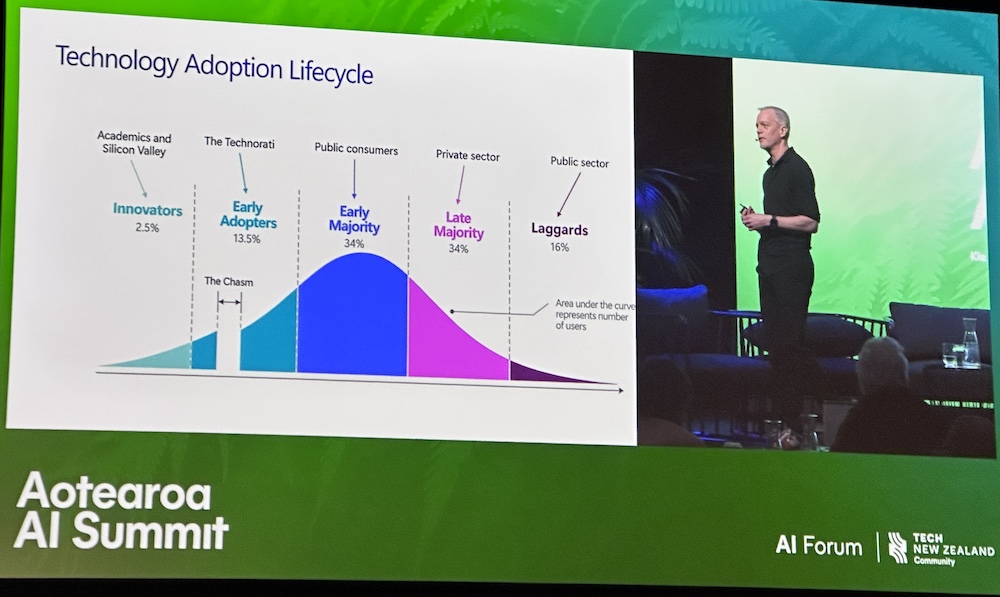
Showing a chart of AI adoption with public sector as laggards, he said one reason the public sector lags is because they have to look after everyone, unlike a private company making a profit.
Multimodal world models using AI will disrupt creative industries that are already disrupted, for example graphic designers.
AI offers the potential for fast feedback loops in science R+D, like trying out things with prototypes and digital twins. I hope more digital twins come to New Zealand soon – they are a cool innovation.
He acknowledged that software developers have had it good for a long time and often enjoyed getting paid well due to high demand, but that is changing. The world doesn’t need wizards anymore gate-keeping software development. He asked for a show of hands of how many of us had vibe-coded but aren’t software engineers and quite a few people in the room had.
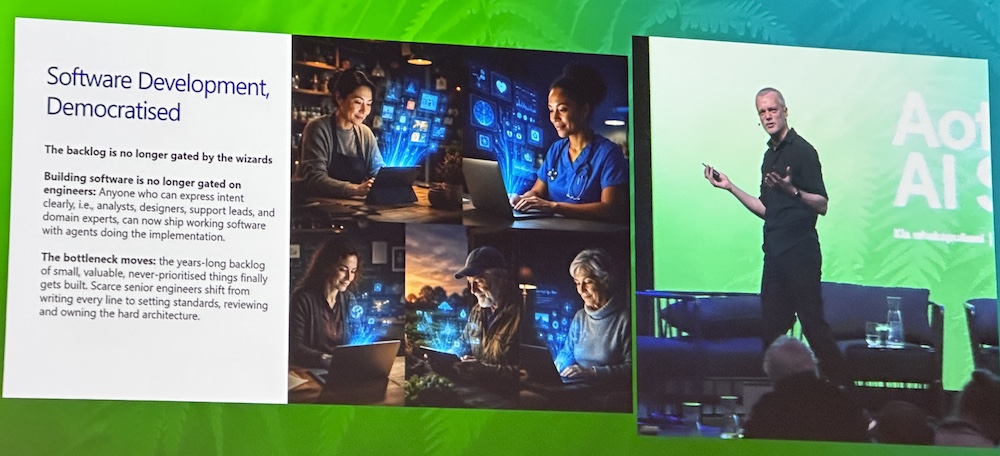
In healthcare AI is making advances as well. In the US, the FDA cleared 295 AI-enabled devices by 2026. AI could help alleviate the healthcare crisis and an aging population.
In education and learning, he gave a great story about how AI could help a child explore all those ‘why’ questions they have, like having an encyclopedia that some of us grew up with, rather than using it for shortcutting to an answer. An AI tutor could teach kids te reo and help keep it alive forever.
Some estimate artificial general intelligence (AGI) coming by 2033.
He noted that New Zealand’s own peer group is years ahead (Singapore, Denmark, Finland, Ireland, Israel), but New Zealand has an ethos of working hard and no. 8 wire. His closing ask to New Zealand was: Let’s not dither or sit this one out.
Keynote: Building the foundations for New Zealand’s AI future, Greg Davidson (Group CEO, Datacom)
Davidson provided data from the Datacom State of AI Index released this month and discussed some of the opportunities and risks New Zealand faces in the AI space.
Speaking on the human review of AI, it must be meaningful, because if a human reviews AI output but doesn’t have the right tools or know-how, it’s just ceremonial.
He drew attention to the physical infrastructure underneath AI, and how residency of data does not guarantee control. There are 5 international cables that connect New Zealand to the internet (see info about Baltic Sea cable cuts). He advised organizations measure the benefit from their AI usage, map their supply chain and rehearse losing it, and decide what is non-delegable to AI.
AI is not one industry but a chain of layers:
- chips & memory
- data centers & power
- cloud
- GPU clouds
- frontier models
- apps & integration
- you (and this layer is currently subsidized)
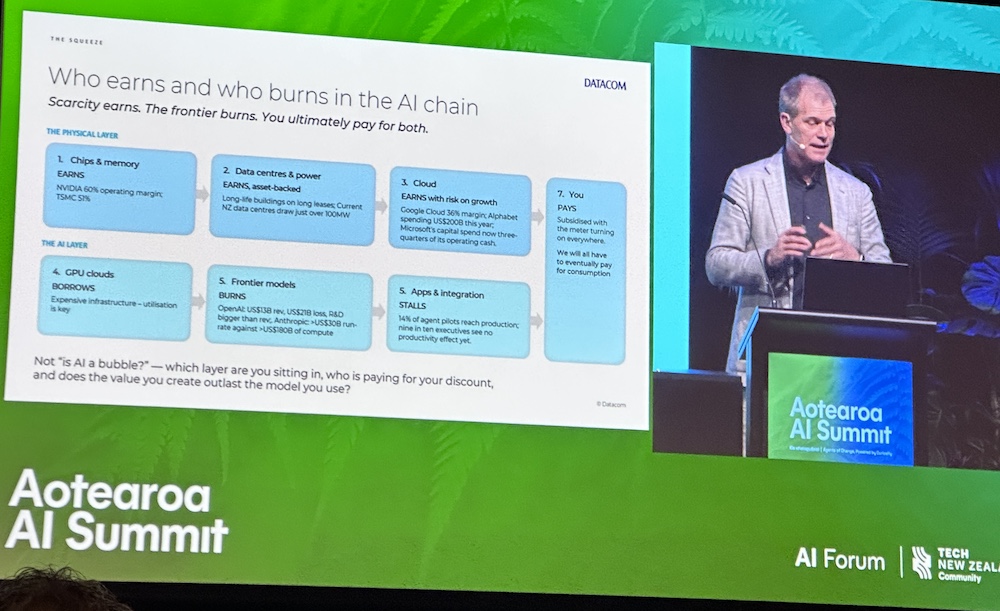
His key contention was that New Zealand can’t own the frontier of AI but it can own the middle and downstream, the middle being energy, grid, and data centers, and the downstream being applied AI in agriculture, health, engineering, and tech exports.
He spoke to the realities of top New Zealand industries: dairy, tourism, and third is tech exports. I think most people don’t know how important tech is to the economy, since it gets less media attention.
He sees an opportunity for New Zealand to be an AI-applied lab for innovation in sectors it already does well; a trusted operator; a talent nation for people who are experts in their own field and in AI; a rule-maker for small countries; and a compute exporter. What he doesn’t want is for New Zealand to be a passive consumer.
Panel: Sovereign Capability in the AI Era: Building the Foundations for New Zealand’s Digital Future, Nick Valentine (Partner, DLA Piper), Megan Tapsell (GM Enterprise & Pacific Technology, ANZ Bank), Martijn Verburg (Microsoft Head of Engineering), moderator: Peter Griffin (Freelance Technology Journalist)
The panel covered a range of issues relating to sovereign capability building. They said we need resiliency for health, defense, and other critical sectors here in New Zealand, and need to focus on 2035 and 2045 outcomes. We can create trusted datasets for New Zealand as a middle player.
While New Zealand has no specific AI legislation, instead relying on existing legislation, the UK and Australia have realized that a lack of legislation leaves it to businesses to figure things out (EU AI Act may be too restrictive but light-touch also a problem). As in the case of copyright, having the Office of AI in Australia will hopefully make it easier for them to license artists’ content for AI training.
OpenRouter tracks open source AI models usage and even US companies are using models not in the US. But sovereignty is not just technical infrastructure issue, but about decision-making and more. AI should not happen at the expense of our people, so building capability should be top of our thinking. We can do niche AI things like Halter in niche areas we’re good at.
In terms of what major banks are doing, ANZ is taking a measured approach to AI, and UBS is requiring all incoming staff to be AI capable & confident.
The digital divide around New Zealand is saddening. One way in is to show people how AI could do something they’re excited about, e.g. someone who is interested in rugby and wants to learn a new thing, like playing rugby with their other hand, could be told about how AI could make them a training program and point them to videos and human coaches to help them reach that goal.
AI adoption without value creation is meaningless.
Going forward, we need robust contracts that discuss dependencies in the AI and tech side.
There’s a leadership vacuum at the moment. One question is: who is the “we” to do capability work? It’s embarrassing how politicians and policy wonks know little or nothing about AI, especially compared to Australia. They need help from people who know AI to make good policies and decide what laws we make.
Keynote: Peter-Lucas Jones (CEO, Te Hiku Media)
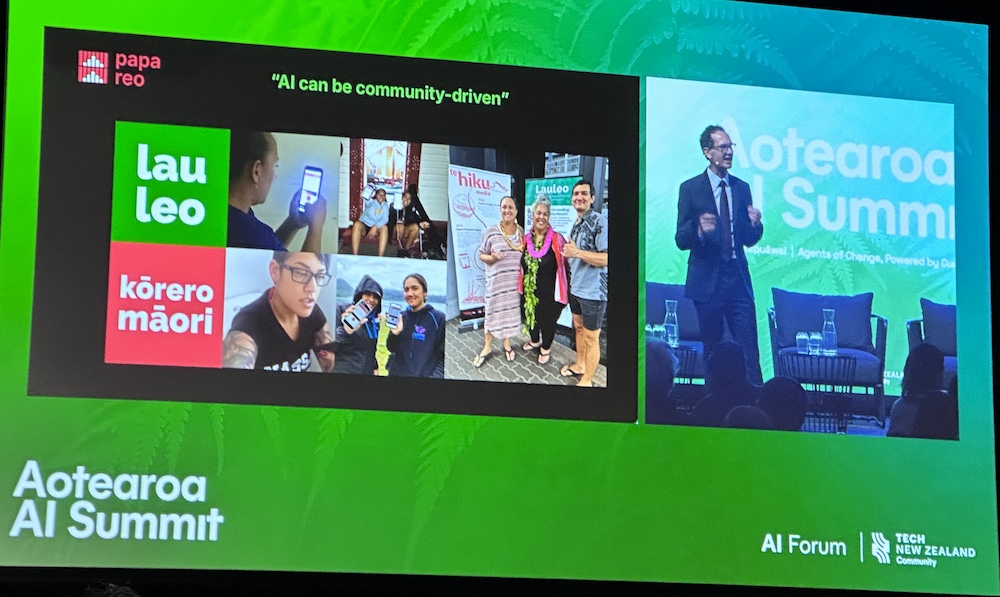
Jones is CEO of Te Hiku, one of 21 Māori radio stations. He framed his presentation on a quote from Karen Hao’s Empire of AI book, which includes a section on her visit to Te Hiku last year and how they are doing AI in a community-centered and ethical way. I reviewed Empire of AI earlier this year. Jones included both a critique of parts of the AI industry and an overview of how Te Hiku is doing things differently.
People ask how much an AI subscription costs, but what about water or other costs? For example, Indigenous Canadians are concerned about data centers on their traditional lands. The cloud is not the cloud; it’s an environmental monstrosity on someone else’s land, out of sight, out of mind.
Privacy is now a privilege; some people who can’t afford a license for AI tools will have their data taken.
Te Hiku’s AI project is doing New Zealand English and Māori text-to-speech, and this allowed the Hawaiki sister language to fine-tune off of their model, so there was an additional benefit outside New Zealand.
People are happy to learn and improve their te reo by themselves in a digital platform, with more privacy, so they don’t have to call up their fluent friend to ask for help with their mihi or pepeha.
50,000 people have downloaded their free Rongo app without even advertising.
Their data pipeline comes from the community they serve. Their AI product is highly accurate in both New Zealand English and Māori at the same time (code switching).
Their AI products include Piki and Kaituhi apps and Papa Reo API. Jones said they want to collaborate with New Zealand businesses.
AI and Digital Technologies: A Human Rights and Te Tiriti o Waitangi Approach, Dr. Stephen Rainbow (Human Rights Commissioner) and Dayle Takitimu (Rongomau Taketake Indigenous Governance Partner, Human Rights Commission)
Outgoing Chair of the AI Forum, Dr Mahsa McCauley, introduced the next set of sessions with a potent line: You don’t earn trust by sidelining the people affected.
Rainbow and Takitimu from the Human Rights Commission noted that the Commission’s report AI and Digital Technologies: A Human Rights and Te Tiriti o Waitangi Approach was published in August 2026. They joked that people don’t often flock to a seminar on human rights, so they piggybacked on AI.
They discussed how New Zealand’s political and ethical frameworks are not keeping pace with this technological revolution, and there are significant labor market challenges. They called for more concerted leadership to build on decades of human rights. Although it’s not just the Government’s role, they do have a key role to play. Australia established the Office of AI and put it in Prime Minister’s office, signalling AI’s importance. If AI is core infrastructure, it should be treated as such. New Zealand needs an AI infrastructure strategy, and to not wait for problems to emerge to put AI governance in place. If we can’t come to a consensus in New Zealand on AI for the public good, then where else?
It’s not about wanting to stifle innovation; New Zealand and Māori have a long history of innovation.
They advised that industry should consider and embed Te Tiriti in AI decisions now, not wait and make Māori go through the Tribunal and courts, etc. just to end up realizing that industry should have done it from the beginning.
New Zealand needs conditions for innovation that is transformative and trustworthy.
Panel: Earning Trust in the Age of AI – Building Social Licence for Innovation, Dayle Takitimu (Rongomau Taketake Indigenous Governance Partner, Human Rights Commission), Prof. Aini Suzana Ariffin (Vice Chair, Science, Technology, Engineering & Innovation Policy Asia-Pacific Network (STEPAN), UNESCO; AI Ethics Expert Without Borders, UNESCO; & President, AI & Robotics, ASEAN CXO Association), Emma MacDonald (Director | Kaiwhakahaere – Centre for Data Ethics and Innovation, Stats NZ), Amy Dove (Partner & Pas Peau Lead, Deloitte NZ), moderator: Dr Mahsa McCauley (Chair of AI Forum and UNESCO NZ Commissioner)
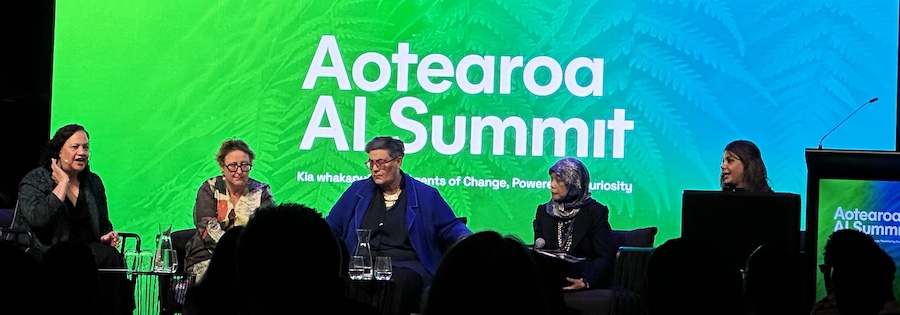
This panel centered on trust and social license and concerns about AI.
People need to see what you’re doing with their data, then can build trust. This is an ongoing responsibility, not just a tick to check at the beginning of the process.
UNESCO’s AI Ethics was first introduced in 2021. The main lesson is that principles can be universal but implementation should be localized. How to put this into practice is a challenge, but over 70 countries have put it into practice through the AI readiness framework.
Also regarding the practical implementation of frameworks: there’s a gap between policy and guardrails and what’s actually happening. Small businesses don’t necessarily have time to figure AI out, and there’s a big commercial risk for them. You need good quality data before you even go near AI, which is something small businesses struggle with.
There’s a difference between consultation and participation; the latter has more say in design and whether something is made.
What happens to people who don’t want to use AI?
Stats NZ needs better admin data from across the public sector to do better and faster research.
Instead of looking at low trust in AI in New Zealand as good or bad, focus on risk; is something low-risk, etc. Yet even if people are using AI without trusting it, when something goes wrong, they will look for someone to blame.
Small-group roundtable: The future of work, facilitated by Chris O’Neill (Creative HQ)
Participants broke into small groups centered on particular topics. I went to the “Future of Work” round table facilitated by Chris O’Neill from Creative HQ.
The group discussed the need to consider new organizational design and move beyond transactional business operations, which AI will only get better at.
One question raised was how to teach critical thinking, and how AI could actually help with this. This connected to a broader question of how much of what knowledge workers do is just busywork. One suggestion was to pair graduates with 55-year-olds, so that graduates can develop critical thinking while seeing how the 55-year-olds use and experiment with AI. AI can also enable more collaboration within an organization.
There is the fact that some AI adoption is being driven by fear of losing competitiveness, there is uneven adoption, and people wonder what to do with the time they are saving by using AI. I suggested we could finally get around to reducing the traditional 40-hour workweek! One person was using AI all day, every day, for years and loving it, while another was hesitant and concerned with privacy of different tools but felt like they might be missing out.
This change to the world of work and career paradigm was a recurring theme. Will it start to impact people’s careers if they can’t or don’t use it at work? And if everyone in a group or team in a workplace is using AI except one person, that person might end up with a lot more work, because everyone else is doubling or more their productivity. Related to this, doing 4 to 6 weeks of work in 4 hours doesn’t allow time for the human to absorb it, leaving the brain saturated or leading to context switching and a bunch of half-done projects.
Panel: From Pilot to Production – Scaling AI for Real-World Impact, Yash Kapoor (CEO and Founder, Innovate Now), Jayne Foster (Principal Advisor | The Policy Project, Department of Prime Minister & Cabinet), Stacy Pence (AI & Data Lead, Accenture), moderator: Stacey Morrison (Broadcaster, MC, author, Māori language translator, interpreter & consultant)
The panel discussed how to have impact with AI across sectors. It was interesting hearing from Foster about efforts in The Policy Project, such as having a community of practice for policy makers and a digital space to share prompts, and doing micro-learning to support the profession. I note that these kinds of efforts aren’t very visible to the public and it would be nice to have more transparency in what’s happening across different departments.
The panel noted how AI can be about better government decision making, not just efficiency. Again, I note that isn’t the dominant media narrative about how the government is thinking about AI. The panel discussed how there’s a need for workforce redesign, meaning figuring out which tasks can go to an AI agent and where a human needs to be in the lead, then doing training and upskilling. Until you do the workforce redesign, it’s hard to know what to train people on.
There are four things pilots need, and most organizations only have two of the four: leadership buy-in, an architecture framework (meaning which tools to use), getting individuals excited about it and fostering a learning culture rather than having them be worried it will replace their job, and thinking toward workforce transformation and redesign.
AI isn’t just about efficiency, but about the new products and services, or customer relationships, you can build with AI. Government needs to be fast followers, not frontier.
Humans think linear, but agents don’t have to. For example, look beyond meeting transcription, or automating just one step of a process, to the whole workflow, like a 48-hour customer onboarding process where a human currently has to check manually, whereas an agent could collect information autonomously and continuously, reducing the time for the process. There’s no transformation with AI if you’re just speeding up an existing process. A key question is: do you want AI in your process, or an AI process?
Quickfire: AI in Practice: Stories from the Coalface, Romain Groleau (New Zealand Technology Lead, Accenture), James Woodward (Transformation Director, Kiwibank), Stacy Pence (AI & Data Lead, Accenture)
This session raised the issue of (usually older) leaders with ingrained ways of working having to learn how to work with AI. Also, a tip was to allow people to come on the journey of AI at their own pace with encouragement; otherwise you get skepticism all the time if you try to push people too quickly, just because you can see all the opportunities with AI and want to implement them.
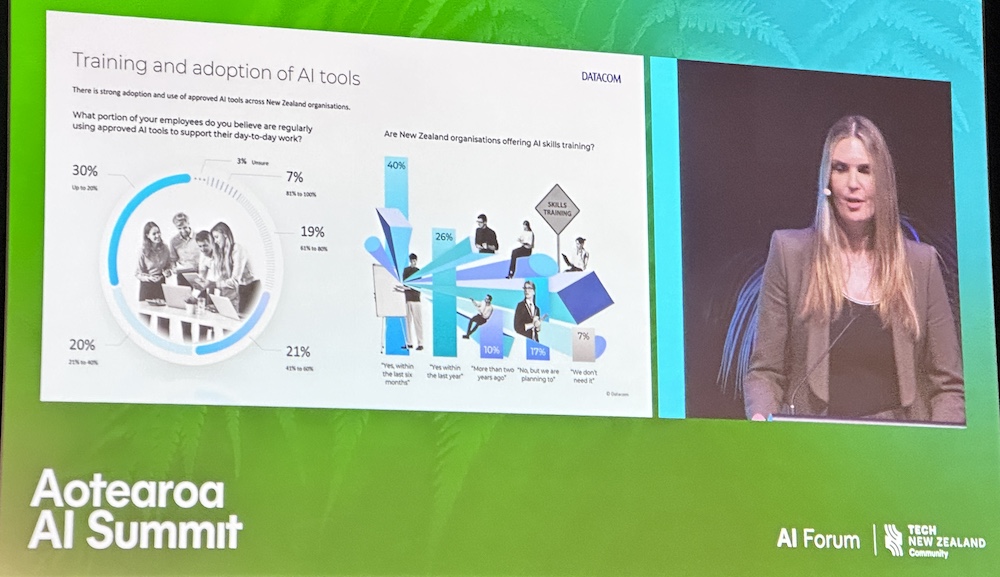
Research insights from Datacom’s 2026 State of AI Index, Lou Compagnone (Director – Artificial Intelligence, Datacom)
This session covered Datacom’s 2026 State of AI Index report. One key finding again highlighting the desire for change in governance around AI is that New Zealanders support following Australia with a dedicated national AI framework (74% support). Other interesting things were that it’s hard to prioritize use cases without anything to measure against, even if you have a Chief AI Officer, and there’s also a big difference between personal productivity and functional productivity. I’d like to read up more on that concept.
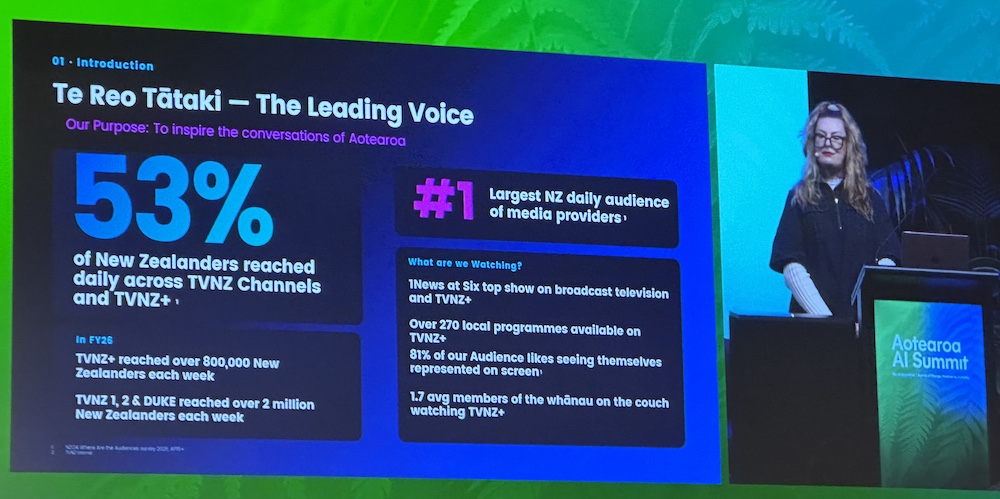
Respecting Tikanga in AI Ecosystems, Stacey Morrison (Broadcaster, MC, author, Māori language translator, interpreter & consultant) & Tuscany Joelle-Hui (Portfolio Product Manager, TVNZ)
Joelle-Hui explained how TVNZ is approaching the use of AI, saying this isn’t about generative AI creating content, but about video metadata extraction to better understand videos, which is currently a manual process. There are three to dos: lead with partnership with Māori from day one, deliver in a safe environment and classify content for sensitivity, and have transparent feedback while being vulnerable. Part of this is creating a low-risk environment where mistakes are okay.
5th Annual Aotearoa AI Hackathon Festival
These AI hackathons across New Zealand are growing a lot year on year, with 2026 seeing 619 participants, 41 judges, and 4 finalists, who gave their quick-fire pitches to the audience. #1 was Waste Opportunity, matching waste producers to groups who could use it. #2 was Te Ara TAEA, helping job seekers by making an AI product for IPS employment consultants. #3 was Kailine that made a much more pleasant phone ordering system using AI for making grocery orders like on Woolworths’ online site, and it supports Chinese and up to 100 or more other languages too. #4 was Kai Rescue, matching excess food with drivers and food banks and helping drivers save trips with more efficient routing. It’s inspiring to hear how much teams can accomplish in the space of a couple days, and AI has advanced so much they can often come up with working prototypes within that time as well.
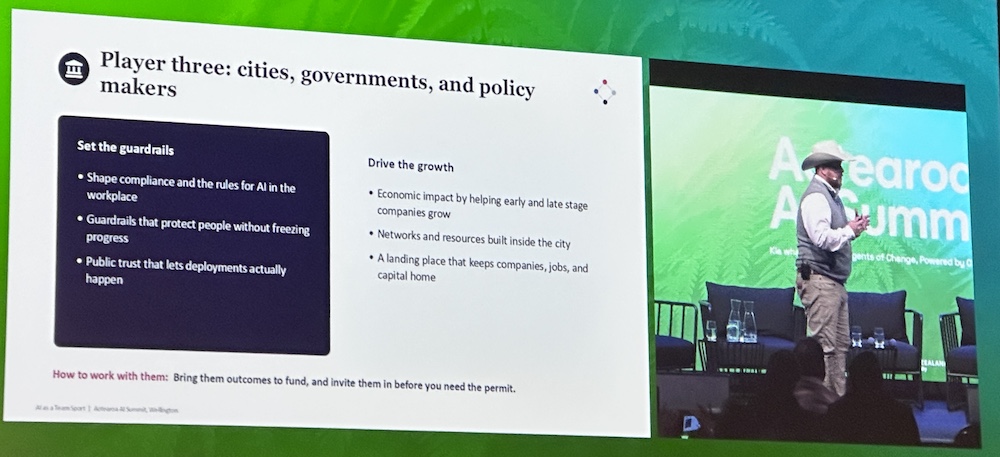
Keynote: AI as a Team Sport, David Steele (Director – Texas; Plug + Play Tech Center, USA)
Steele used a sports analogy to discuss the success of the tech ecosystem in Texas. He said an ecosystem requires four players to take the opportunity: startups, corporations, cities and governments, and universities. So much of top minds’ research stays in white papers or in a professor’s mind, trapped away and not commercialized. He suggested startups go get them and put them on your team, because they think differently. He offered five examples in Texas: Sugar Land and Houston Metro, Frisco, McKinney, Bryan and Texas A&M, and Cedar Park. All are attached to a university. To get started, he said pick a problem and set a table for all four players, start the conversations, then practice, practice, practice.
Day 2
Incoming Chair of the AI Forum, Maria Mingallon, shared reflections throughout the two days, including that AI has gone from emerging tech to boardroom tech, from a tech convo to a national convo, and whether and how AI-native businesses will disrupt established corporations. She challenged us to reframe AI in the workplace: don’t think about what AI can do for you or your team; think about what future can we create together?
Keynote: Workforce Transformation, Dr Viveca Pavon-Harr (Global AI & Data Lead, Public Sector, Accenture) & Louise Barrere (Global OpenAI Lead, Accenture)
Pavon-Harr and Barrere discussed workforce transformation and thinking differently about the future of work. Anchor your approach to AI on what problem it’s solving, and don’t spend months documenting your current state processes and making incremental improvements. This is not transformative. Focus on the next step instead. “Just put some AI on it” is the wrong first step. They gave the example of totally rethinking how to better do security for a FIFA World Cup game, enabling the use of machine learning to deploy security smarter, in a way that was different than what was currently being done. They cautioned about trying to replace your SAAS with doing it yourself.
Their example of Henry Ford moving away from having pods of workers around steam engines to redesigning the factory around electricity could use either more problematizing or a different example. There are lots of problematic things about using Ford as a model, including his personal beliefs and treatment of workers, and whether the assembly line resulted in the very dehumanizing of workers that some are seeing happen again with AI, but the point was that AI will require a redesign of workflows more broadly, like was discussed in this BBC article from 2017, Why didn’t electricity immediately change manufacturing?). They said it took Ford from electricity being widely available in 1890 to making the Model T affordable in 1920, but we don’t have that long to take up AI.
I liked their analogy of a lanyard at a conference making it visible who you are and that you meet the registration requirements to be there, so should tech and AI governance and decisions be visible too, not a black box, and organizations should be open about costs and other details.
Panel: Augmenting Human Potential – AI, Skills and the Future of Work, Ana Ivanovic-Tongue (Chief Delivery Officer, academyEX), Nilay Rathod (GM Group Architecture & IT, Spark), Amanda Veldman (Senior Learning and Development Advisor, Datacom), Te Rohu Crow (LLB/BA Victoria University of Wellington student), moderator: Louise Barrere (Global OpenAI Lead, Accenture)
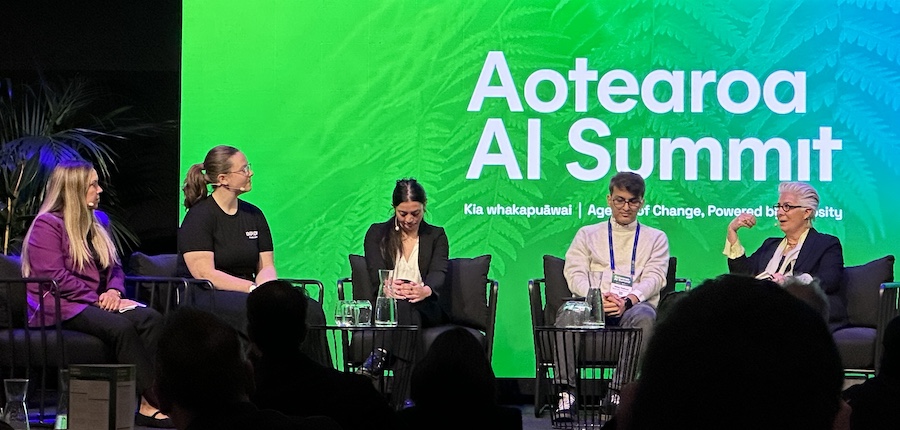
This panel covered the topic I’m very interested in – how we prepare people with the skills they need to understand and use AI. They discussed how we need to ensure people are up to date and confident, and people need to be supported to change their identity at work. And that AI is not optional for New Zealand due to a retiring population and aging workforce, with a 2:1 ratio coming soon.
Te Rohu Crow brought a young person in university’s perspective to the panel, which was much needed representation from the generation coming into the workforce. From a graduate’s perspective, she said the job application process is losing human connection, since sometimes you can go through three rounds of talking to a computer. Youth opinion is very divided about AI: some don’t see any value in it, versus those who have found value, and a lot of that is a gap in education. There needs to be more upskilling in using AI as a tool, not just being able to do something; otherwise it’s dependent on whether a company can provide that upskilling. I see this as a continuing challenge for tertiary and earlier levels of education, which have a model that has not addressed technology in a way that ensures everyone has a base level of digital literacy.
The panel discussed things such as how do you organize your workflow for more useful outcomes, like what would you do if you were starting from scratch with designing a customer call center?
There’s a shift away from the tools conversation toward other skills needed, like judgment, checking bias and accuracy, and relationships. Some organizations aren’t doing proctored exams anymore, because it’s not fair to make people go in every 6 months to keep up. Another challenge is trying to update internal learning modules all the time.
One strategy is to look at doing microlearning, such as giving staff 15 minutes to jump into a topic and then apply it to their work, enabling them to learn throughout their day. Also, encourage showing successes and failures with AI to peers and teams. Someone mentioned helping people lean into their strengths and referred to an archetypes idea from an AI podcast; figure out who is the prototyper, the editor, the cleaner upper, etc. and then let people use more of their natural inclinations. Also, some people love their task and want to opt out of using AI for it or adopting AI. Equitable access to a tool does not equal equitable outcomes and benefits. Don’t assume capabilities, ensure fundamental outcomes. Yes!
I liked the acknowledgement that everyone is behind the hype and the frontier of AI, and it’s okay to take one first step; you don’t have to be automating your whole day or using the latest model. I know I feel this pressure at times, and sometimes you have to focus on one process at a time.
Panel: The Productivity Dividend – Turning AI Efficiency into Economic Growth, Steve Elliott (NZ Public Sector Lead, Adobe), Hema Sridhar (Deputy Director, Koi Tū – Centre for Informed Futures), Dr Viveca Pavon-Harr (Global AI & Data Lead, Public Sector, Accenture), moderator: Carol Hirschfeld (Journalist, TVNZ)
This panel addressed the perennial New Zealand issue of low productivity. My favorite idea they mentioned was that instead of a book club, people could create an AI club where they try to build a new tool with AI. I would like to see this happen across New Zealand – make AI less intimidating by putting it in a familiar setting! Their thought was to be curious, don’t look at AI as a chore, make it fun, do it with a partner or friends or kids.
The panel discussed how measurement can be not just ROI, but how to improve people’s lives. For example, if you’re gathering data on diabetes for one reason, like tracking numbers, you might consider how you can use that data to prevent diabetes as well.
They said we want a productivity gain that’s not just a blip for New Zealand on a flatline of productivity over the years. That means looking at how our young people can be prepared for an AI world. Currently businesses and individuals are seeing productivity gains but can’t point to a tangible benefit. The Adobe Readiness Report was recently released.
Sridhar talked about a recent trip to Delhi, India, where it seemed like everyone knew about AI, had a kid studying it, was applying for seed funding, etc. There was widespread awareness and this is backed by reports showing India is a high adopter, and it has a population with an average age of 30.
Another international example given was Abu Dhabi, which said they’re going to be AI native by 2025, and made it a civil society benefit, so people could use an AI tool to report roaches and potholes, thus making people want to use AI and see the benefit.
The panel talked about how we’re in an era where we need a new social contract. We need a baseline for experimentation, to allow failure, and to empower an AI champion, often a younger person, to support others. We need to enable people to grow by sending them to this conference, and things like it. Also, we need traditional AI and deterministic systems from decades previous to anchor the LLMs.
They talked about generational gaps and how we need knowledge transfer. An older person teaching a new graduate has not just an age difference, but a difference in technology and ways of thinking. That person might tell the new grad “Here’s an Excel sheet, have fun,” but maybe it’s because they only had Excel 25 years ago, and so now is a chance to rethink the process. They suggested people be open to whom they’re learning from.
There is the issue of humans not being able to do deep thinking, high cognitive tasks, or review AI for 8 hours a day. This is the chance to restructure the day, since staff can’t necessarily do more with the hours saved. One tip to prevent burnout with AI is to go back to a human sounding board, explain it to another person in a 30-second pitch, which is not quite human in the loop but something else.
They challenged everyone to confront tall poppy syndrome and New Zealand exceptionalism, etc., that is holding the country back. We need leadership at every level, not just the Prime Minister, but also individuals, families, and iwi. No one is coming to save us!
Keynote: John-Daniel (JD) Trask (Co-founder & CEO, Raygun; & co-founded & CEO, Autohive)
The closing keynote was a spicy one from JD Trask, who challenged the room to seize the opportunities that AI presents to NZ.
He said he doesn’t like talk of governance, risks, and burnout, and thinks we need to look at the opportunity instead. At Raygun, he said they spent one bullet point in a leadership meeting on ethics and governance, as in, they didn’t hand-wring about it. Software overcomes New Zealand’s great limitation of distance, taking milliseconds to get products to market, and it’s greener too. Otherwise, we’ll be here in 5 years still talking about governance while sending all our money to OpenAI and Anthropic. New Zealand’s biggest industries, primary and tourism, are fairly safe from AI disruption, people need to eat, agtech like Halter is doing well, and people like experiences.
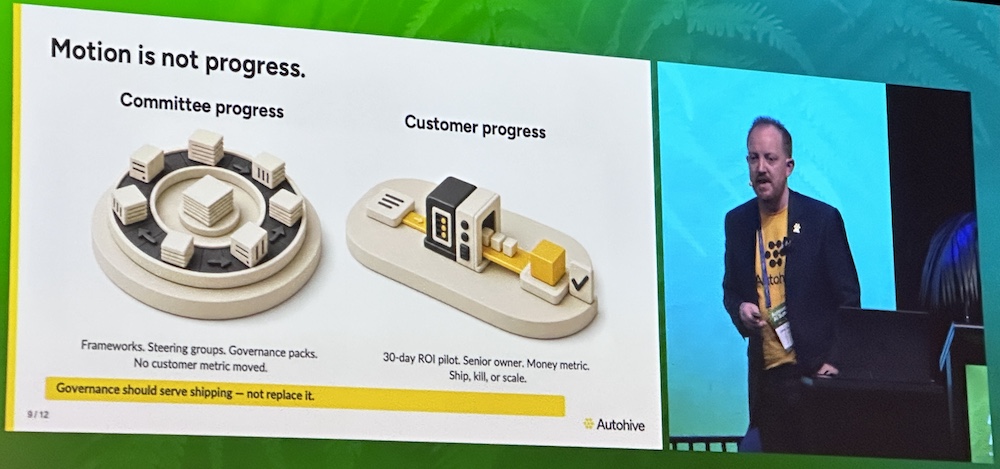
But when it comes to AI in New Zealand, he said, we’re 3.5 years in and don’t have much to show for it. He thinks AI will be bigger than electricity. There’s so much opportunity, everyone in the room could start an export company and still probably not compete with each other.
He called out Microsoft as being losers in the AI space, with quarterly layoffs at Meta, Amazon, and others. He asked the room, Who chose Microsoft for their AI? It’s a lazy choice, like choosing IBM in 1995.
He also criticized the idea about taking people on a journey with AI: it’s been 3 years, and if they’re not on the boat, that should be it. He also advised people to be careful of where they’re working: If you work at a company with 100 or more staff, get out. If you’re not using AI at work, they are making you unemployable. He said if you apply for a job with him, and all you’ve done is a few prompts with generative AI, you won’t make it to the interview.
He made a jab at the government’s MBIE: I heard MBIE rations Copilot licenses, do they know what the I stands for? and a jab at the new job title of Chief AI Officer. He said this is not a real job – do you have a Chief Electricity Officer?
New Zealand has a small business advantage, fewer people to say no. Think beyond cost cutting, what else could we do? We need to do the doing – there’s only so much you can read or learn about AI; eventually you have to get on and use it.
“I’m still waiting for my boss to approve my license” is a disgrace to New Zealand when he hears it. The goal should be to reduce the workday, that’s what employees get. Yes, keep a human in the loop, but now they don’t have to dredge through data anymore.
He offered three takeaways at the end: the CEO needs to be on board, otherwise leave; replace theatre with a pilot using AI; and design for export.
Workshop: The Visibility Imperative: How to get found in an AI-first world (William Franks, Principal Solutions Consultant, Adobe)
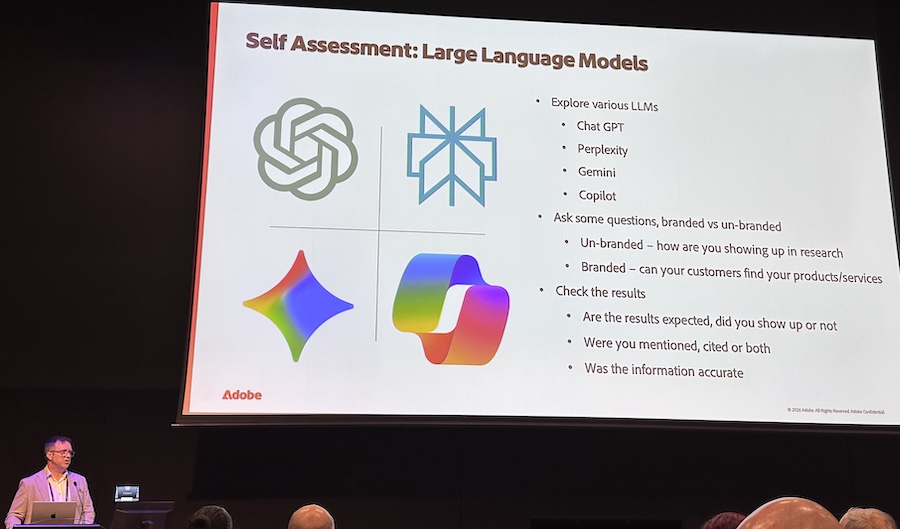
The end of the conference had various workshops to choose from. I attended the one about how AI is impacting search and web traffic by William Franks from Adobe, which I know for their creative cloud products but not all of their other offerings. He took us through some free resources to use for testing our websites:
- AI Content Visibility Checker, powered by Adobe Brand Visibility Chrome extension
- iPage Speed Insights at pagespeed.web.dev (try using on pages besides your homepage)
- In the Chrome browser, under Inspect, Lighthouse can do SEO and other analysis.
If these tools flag errors or problems, you can take a screenshot and give that to AI to help fix them. I know AI is useful for tech support, so this is part of using it to help with technical issues outside the scope of your skillset.
The Adobe AI and Digital Trends Report 2026 and Forbes say 57.5% of all web traffic is now bots. So the question for individuals and organizations with online content is whether their content is visible to AI agents.
We learned that AI companies don’t reveal specific data or people’s prompts into their LLMs, but they do sell prompt topics, like “what’s the best espresso machine” which might be useful to those in the coffee business. The paid Adobe tool he showed us allows you to see a prompt library related to your business area, so for the coffee example it might be prompts like how to make the perfect espresso shot, or which countries produce the best coffee, then the Adobe tool will run these prompts blind for you in various LLMs. Then you can measure yourself and the sentiment about your brand against your competitors.
An important thing most people don’t know about how LLMs or bots process internet sites is that they can’t execute JavaScript to load content the way humans can see it. So if there is a dynamic site with JavaScript, it’s possible AI can’t access it. One way around this is to make it so you have a human version of your site and then an AI version. For example, you can tell your CDN that if any bots come to your page, send the bots to a markdown version of the page instead of the JavaScript site built for humans. The Adobe tool does this automatically with a click. You can also have information like FAQs visible to bot and agent traffic but not visible on the website itself.
The key concern is whether LLMs are telling the right story about your brand. Understanding business impact matters too, so if you are seeing LLM referrals, you should consider what does that actually mean for the business.
Find out more about the Aotearoa AI Summit and see official photos from the event.
And if you want to compare with last year’s event, check out my notes on the 2025 Summit.