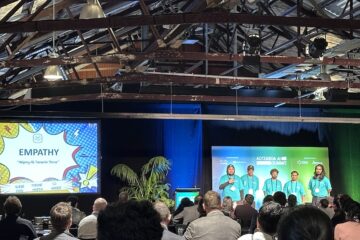
This AI literacy policy roundtable in August 2026 explored the place of AI literacy in Australia’s AI Plan and was presented by the Centre for Artificial Intelligence and Digital Ethics (CAIDE) at the University of Melbourne in collaboration with the Asian Venture Philanthropy Network (AVPN) under the umbrella of the AI Opportunity Fund. I was invited to discuss some of what I have learned in providing AI training to people outside the workforce and/or with low digital skill levels, in an initiative I am coordinating in New Zealand as part of that Fund. To enable free and frank discussion, we agreed to not identify speakers or affiliations, so I have consolidated the points I found interesting into themes to provide a flavor of how people are thinking about AI literacy in Australasia as we near the four-year anniversary of the release of generative AI technology to the public. It was an intellectually rich and stimulating interdisciplinary experience that I’d recommend other groups working on the challenge of AI literacy try out!

Links
Australia’s National AI Centre, National AI Plan, and Guidance for AI adoption: implementation guidance
AVPN’s AI Opportunity Fund
Themes
Government
One challenge is that there is no common definition of AI literacy or AI since it’s actually a range of technologies. Regulatory certainty around AI is important, including for developers of these systems. There are lessons to be learned from large organizations that were already using traditional AI and have responsible use policies that can serve as models for smaller organizations that lack the resources to develop these themselves.
Well-intentioned initiatives such as government-sponsored AI chatbots developed years ago are now out of date, and students don’t want to use them. Sometimes schools haven’t even heard of these types of chatbots.
Equity and Diversity
The topic of equity asked us to consider aspects of AI that can be confronting and challenging. As AI makes its way into many aspects of society, it becomes more intertwined with power, as in recruitment processes, insurance decision, policing, and service access. Questions of provocation included: What should people know about Diversity, Equity, and Inclusion (DEI) and AI? Who were AI systems designed for? Whose values shape those systems? Does a person using the system have the confidence and agency to challenge the AI output, or do they just accept it as is? Is inclusion operationalized, or does it remain at a surface level with principles about fairness? Does AI literacy education include info about differences in how AI is built and the gaps in its training and operation? The idea surfaced that the beneficiaries of AI literacy should be part of co-designing AI training, because no designer can anticipate all the factors a community might need.
There is not one AI literacy pathway for everyone; people have different languages, levels of trust, etc. For example, First Nations people may have data sovereignty and unique cultural context to be considered. AI literacy can be embedded in people’s existing systems of meaning. Different cultures and faiths already have ways of discernment and metacognitive strategies that could be transferred to the topic of AI.
Foundational gaps in people’s digital literacy (e.g. how search engines or the cloud actually work) can undermine their ability to develop AI literacy, in part because concepts like model training or bias in datasets have no scaffolding to attach to. Standard AI literacy materials often assume workplace context, a certain level of education, and reliable device and internet access that some people may lack. Also, the widening gap between free and paid AI tools means people on low incomes are often only able to use free AI tools that come with privacy and security limitations so can’t build AI skills beyond a certain point.
K–12 Education
Many schools have been left to combat the problem of AI literacy in their own individual way. Parents often have no idea about AI in schools so can’t help out much with their children’s education about AI, placing the burden on teachers. Even if school staff are trained on one AI system, that doesn’t mean they know how it works or can transfer that knowledge to other systems. And schools want help with writing AI policies.
Teachers often fall into 3 buckets when it comes to AI: concerned, curious, or confused. They need skills to critically review AI output, to talk to students about AI and explain it to them, to know enough about privacy and risks not to do things like uploading photos of young people to free AI tools that train on data, like the non-enterprise versions of ChatGPT, and to rethink assessment and redevelop assignments to not be take-home. A challenge is that schools are up against vendors who are pushing AI tools, and recent changes to return to explicit instruction mean that teachers don’t have a lot of room to advocate for having the flexibility to adapt curriculum to their students’ needs. The fixation on AI and cheating has eroded the trust relationship between students and educators. Taking into consideration the threat that Rebecca Winthrop calls “cognitive stunting” is also relevant in addition to the concept of cognitive offloading.
Shadow AI use is happening not just with workers but with students too, meaning that if they are banned from using AI or a certain AI tool at school, they can resort to tethering their phone and accessing other AI tools using their mobile data, or using other AI at home.
There are noticeable differences in terms of well-resourced schools and less-resourced schools. For example, a private school might have switched-on students asking complex questions about AI and autonomous weapons use overseas, while a public school might have a variable degree of support for learning about AI. One important insight was that students in poor schools may be particularly wary about how they are perceived to use AI versus their more well-off peers. They might be viewed as lazy and not thinking for yourself if they use AI, whereas a student from a privileged school might be lauded for learning how to prompt AI better. This can lead to students being skeptical about AI literacy programs and whether such as program might cement them into a low educational attainment track, or at least the perception of one.
Higher Education / Universities
A challenge is that different institutions still define AI literacy differently. A key point is that AI fluency does not equal literacy: using a tool doesn’t mean you are literate! The battle to not consider young people digital or AI natives continues. AI skills have to be layered: not everyone needs to vibe code or build AI systems.
Ideas for teaching AI at the university level included focusing on capabilities rather than AI tool features and helping develop humans’ competence to choose how much agency to give AI versus themselves. There was a desire for universities to step up and take on more boldness and leadership in the age of AI, rather than merely responding. AI literacy needs to be embedded in higher education, beyond just adding a lecture on AI literacy or AI agents.
Comparing experiences training staff and students in AI literacy, staff tended to have a more traditional view of approaching AI, as in they wanted to understand it first, ala Bloom’s Taxonomy, whereas students were the opposite: they started at the creation level, making thing with AI, before moving to understanding it.
Employment
Some research shows that individuals have an incentive to hide their AI usage, seeing it as a sign of cheating, laziness, and/or incompetence. It needs to be acknowledged that most people lack agency and power around AI development, and as workers they often don’t have a say in its rollout.
Caution is needed in rolling out AI to different sectors. For example, in healthcare settings, the introduction of AI for case notes has typically been promoted as a good time-saver, but this overlooks that writing up case notes has often been an important part of reflection for staff that they need to know how to do and may value.
AI can be reframed as a productivity tool versus a job displacement mechanism to reassure workers. In some places such as Indonesia, AI skills have become mandatory for government job seekers. Employers need to train workers in AI if they want the benefits, and since workers with expertise are the ones who will make AI successful, they should be involved in the discussions and decisions made regarding AI in the workplace.